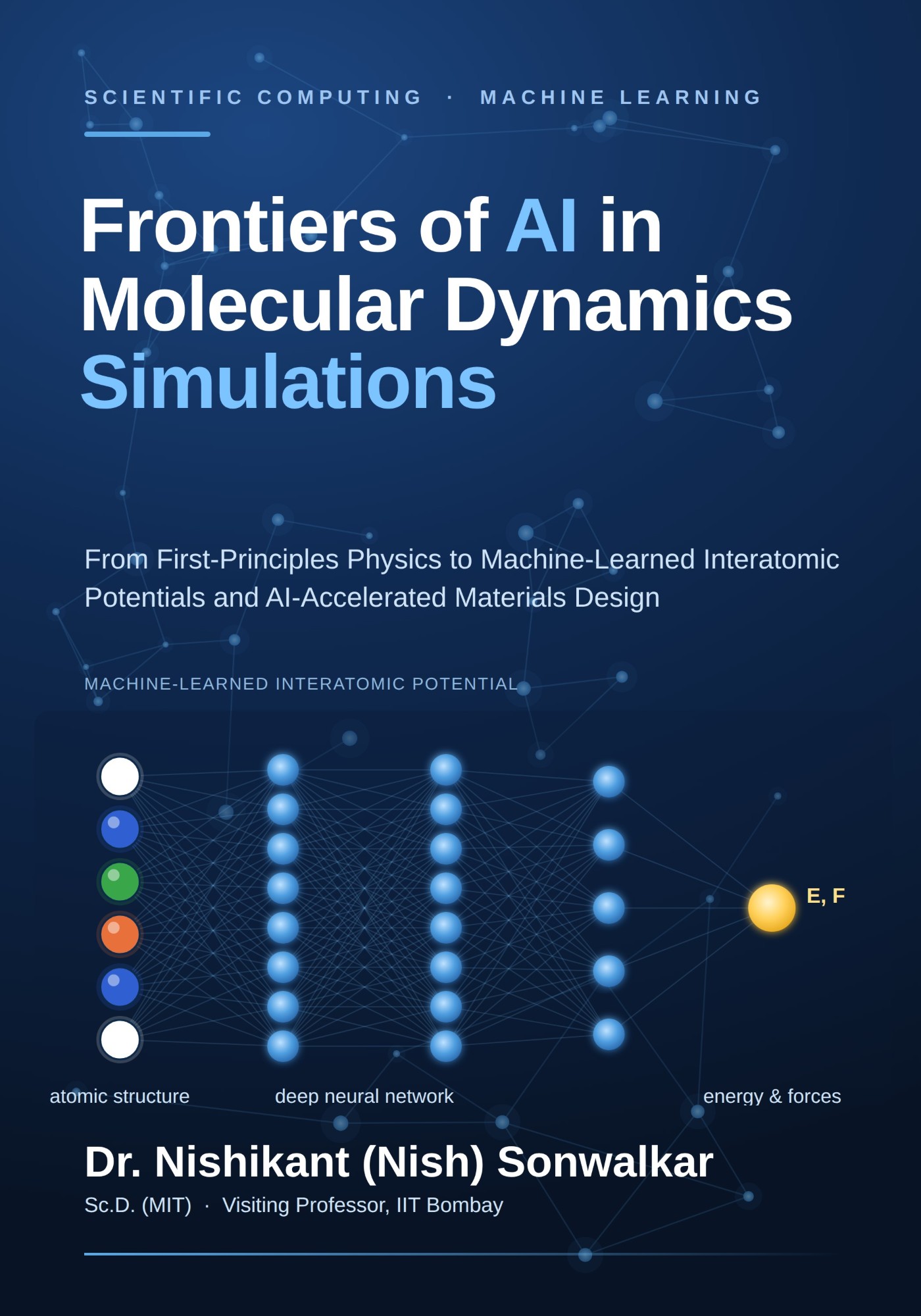
Frontiers of AI in Molecular Dynamics Simulations
From first-principles physics to machine-learned interatomic potentials and AI-accelerated materials design.
Simulating matter in the age of machine learning
Artificial intelligence is changing how we simulate matter. For decades, molecular dynamics was limited by the cost of accurate force calculations. Machine learning has now removed much of that limit.
Written for graduate students, researchers, and R&D practitioners, this book brings first-principles physics and modern machine learning together in one framework. It begins with classical thermodynamics, statistical mechanics, transport theory, and density functional theory. It then moves on to machine-learned interatomic potentials, graph neural networks, Gaussian approximation potentials, Δ-learning, and AI-enhanced sampling.
With more than one hundred figures, the book moves from theory to validated application: neural-network potentials, the recovery of phase transitions and radial distribution functions, thermodynamic consistency, and AI-optimized photonic smart coatings.
“Optimization is the shared language of thermodynamic equilibrium, electronic structure, and neural-network training.”
The central theme of the bookFrom first principles to predictive simulation
The book follows one line of argument, from the physics of matter to AI models that can predict how materials behave.
Physical Foundations
Classical thermodynamics, statistical mechanics, transport theory, and statistical ensembles.
Ab-Initio Methods
Density functional theory and the electronic-structure calculations that supply reference data for learning.
Machine-Learned Potentials
Neural-network potentials, Gaussian approximation potentials, and Δ-learning.
Graph Neural Networks
Message-passing and equivariant architectures for atomistic systems, including SchNet and NequIP.
AI-Accelerated Dynamics
Faster simulation and enhanced sampling of rare events while keeping results thermodynamically consistent.
Materials Design
Phase transitions, radial distribution functions, and AI-optimized photonic smart coatings.
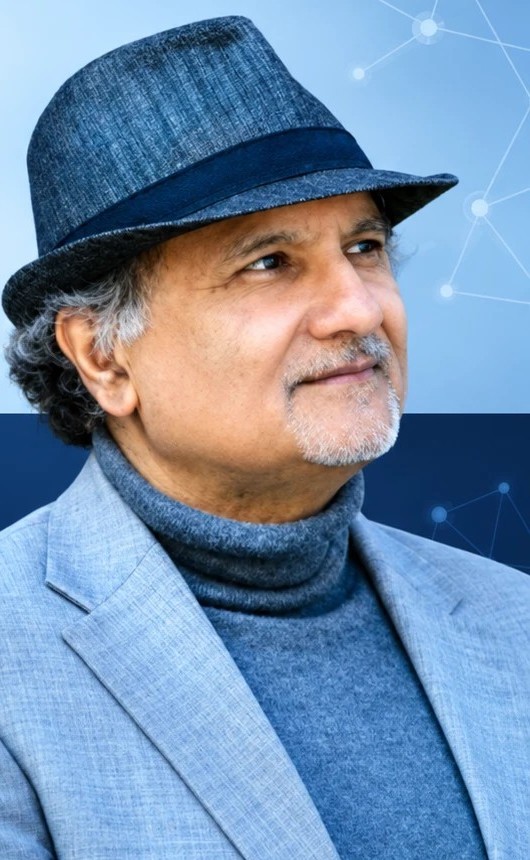
Dr. Nishikant (Nish) Sonwalkar
Nishikant Sonwalkar is a scientist, inventor, and serial entrepreneur. His work covers solar energy technology, molecular dynamics simulation, and Raman spectroscopy of material interfaces and nanomaterials.
His current research covers spectral conversion of solar radiation and light–matter quantum interactions for photonic and plasmonic enhancement in nanocrystals.
Get your copy today
Ebook on Google Play Books, $19.00. Hardcover edition coming soon.